
ARPG - Combat Prototype
Playtest footage from my final school project, showcasing the combat system and gameplay systems I designed and implemented.
Role
Combat Designer
Game Designer
Systems Designer
Engine
Unreal Engine 5
Project Type
Final School Project
Duration
September – December 2025
Project Overview
ARPG Combat Prototype is a personal game design project focused on creating a complete action RPG combat experience. The project combines combo-driven combat, enemy AI, abilities, progression, itemization and gameplay systems into a playable prototype.
Design Goal
1. Fast-Paced Hack-and-Slash Combat
Create an aggressive combat experience where the player is encouraged to stay active and maintain offensive pressure.
2. Ability Synergy & Player Expression
Encourage players to experiment with different abilities and discover synergies between them, allowing for different approaches to combat.
3. Responsive & Impactful Combat
Make attacks feel satisfying and responsive through hit reactions, knockback, stun, knockdown, camera feedback and other forms of combat feedback.
4. Readable Enemy Encounters
Make enemy attacks and behaviors readable enough for players to understand when to attack, dodge or react, while still creating challenging encounters.
Inspirations & References
Godfall
I was particularly inspired by its fast-paced melee combat and its emphasis on aggressive, ability-driven gameplay. I wanted to create a similar sense of momentum while giving players different ways to approach combat through attacks and abilities.
Devil May Cry
I wanted to create a highly combo-driven combat system with multiple ways for the player to approach encounters, with a strong focus on fast-paced hack-and-slash gameplay.


<-- Stamina
<-- Rage


Items Rarity


World Event
AI Design
I placed a strong focus on attack readability and telegraphing, ensuring enemy attacks were clearly communicated and gave players enough time to react.
Each enemy family, Orcs and Skeletons, included different combat roles such as Tanks, Ranged Damage, and Melee Damage.
I designed these roles to create synergies between enemies, forcing players to adapt to the composition and situation of each encounter.
Boss Encounter
The boss abilities were designed around player reaction, timing, and evasion, challenging the player to quickly adapt to their surroundings and analyze the boss's current phase.
For example, when the boss reaches 50% health, it gains a large area-of-effect ability that deals continuous damage and slows the player while they remain inside the area.
This forces the player to recognize the new threat, reposition, and adjust their approach to the encounter.
Skill Tree
I designed the skill tree around the player's two main abilities: the Utility Ability and the Ultimate Ability. I didn't want the skill tree to simply provide basic stat increases, so I focused on creating meaningful and impactful choices that directly affected gameplay.
Each section of the skill tree is associated with one of these abilities and offers two different upgrade paths: Evolution and Reincarnation.
The Evolution path improves the existing ability while keeping its core behavior, making it more powerful without changing how it is fundamentally used. The Reincarnation path completely changes the ability's behavior, allowing the player to use it in a different way.
This creates multiple ways to build a character depending on the player's preferred playstyle. Between these major gameplay-changing upgrades, the tree also contains smaller and medium upgrades related to the associated ability, providing more gradual progression between the major choices.
Design Inspiration — Black Desert: The skill tree was inspired by Black Desert, particularly its approach to branching abilities with gameplay-changing upgrades.
Stats
The character had three main stats: Damage, Armor, and Evasion. Damage increased offensive power, Armor provided damage reduction, and Evasion gave a percentage chance to evade incoming attacks and abilities.
I designed these stats to support different playstyles. High Damage with low Armor could create an assassin-style build, while higher Armor and moderate Damage supported a more warrior-oriented build. Itemization reinforced these archetypes, with high-Damage items providing more Evasion and defensive items favoring Armor.
The player also had Stamina, which was used for dodging. Since dodging provided a brief period of invulnerability, Stamina prevented players from relying on dodge indefinitely.
Rage was used to activate the Ultimate Ability. It was generated by attacking enemies but gradually depleted when the player stopped attacking, encouraging players to stay engaged in combat to build and maintain their Ultimate resource.
This allowed players to experiment with different builds instead of following a single linear progression path.
Special Items
Special item powers were designed to significantly change the way the player approaches combat, but in a different way from the skill tree.
Rather than modifying a specific ability, these powers could introduce entirely new gameplay effects that influenced how the character was played.
Equipping these items was therefore a key part of building and specializing a character. Their unique effects could fundamentally change the player's approach to combat, creating new playstyles and adding another layer of depth and diversity to character builds.
Design Inspiration — Diablo 3: The concept of powerful item effects that can significantly alter a character's playstyle was inspired by Diablo 3.
System Designed
Combat System — attack combos, ultimate attacks, juggling mechanics, hit reactions, stun, knockdown, knockback, dodge, and a variety of unique abilities, each requiring custom setup and implementation, such as the Hook and Knockdown abilities.
Gameplay Systems — inventory and a deep itemization system featuring rarity, item variants, item traits, and randomized loot, alongside waypoint, checkpoint, and consumable systems.
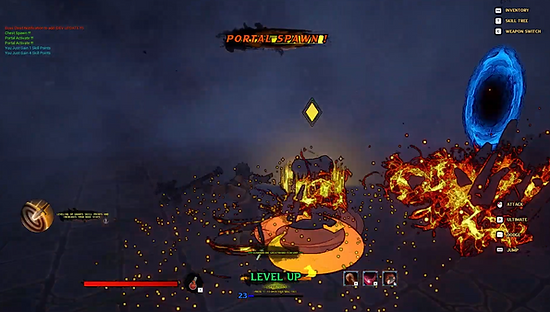
World Events System — a dynamic objective system where completing specific objectives within designated areas, such as defeating a set number of enemies, triggers rewards including XP and special chest spawns. Boss objectives can additionally spawn a special portal upon completion for returning at the start of the dungeon.